
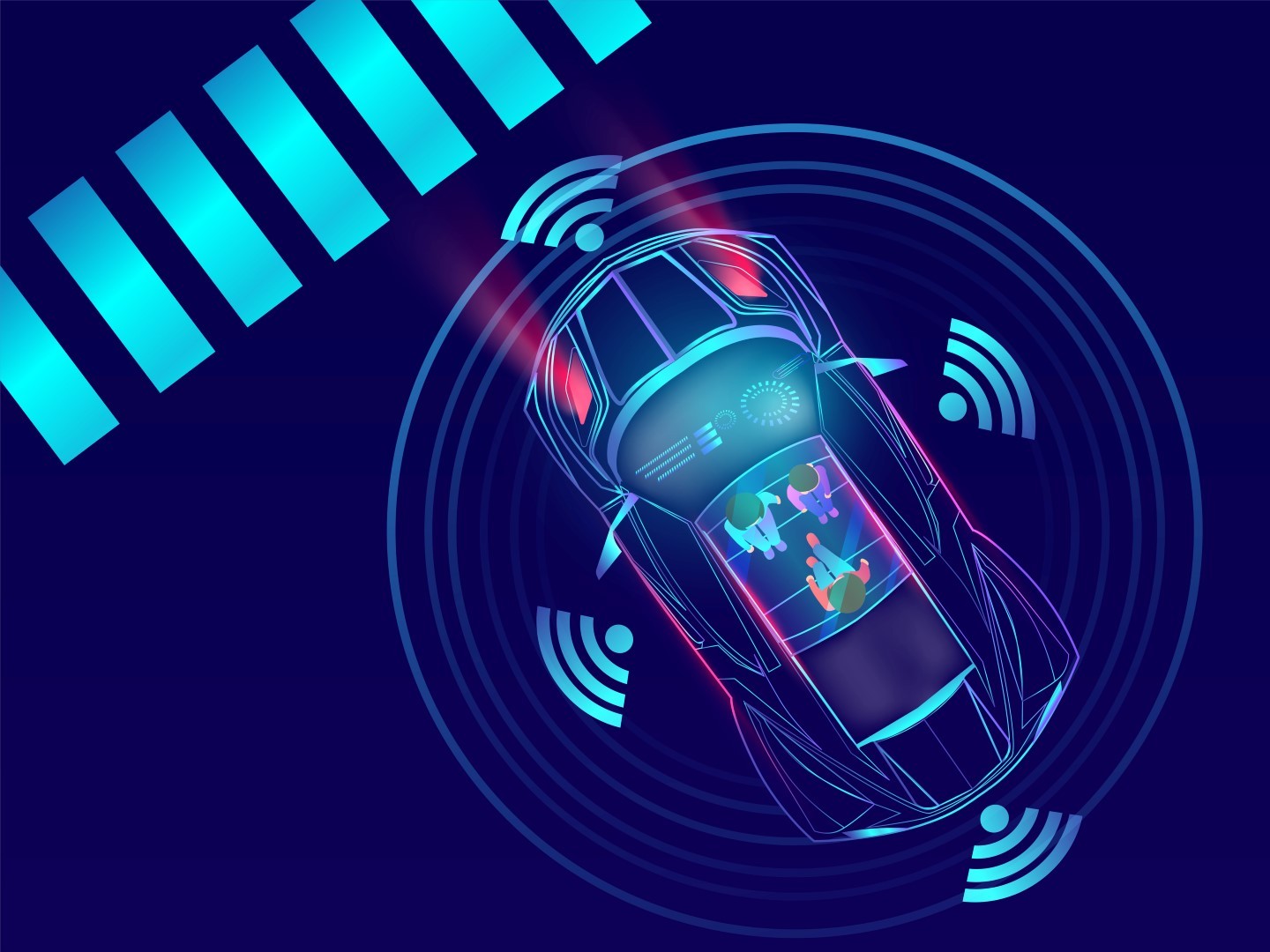
The Connected Intelligence Stack Behind Autonomous Mobility
Autonomous vehicles do not operate in isolation. They depend on a layered connected intelligence architecture that extends far beyond the vehicle itself.
- Edge AI: Real-time perception, prediction, and driving decisions inside the vehicle
- Cloud AI: Fleet learning, simulation, software updates, and model improvement
- GenAI: Customer support, trip assistance, incident intake, and personalized in-vehicle experiences
- IoT and V2X: Communication between vehicles, infrastructure, depots, sensors, and fleet systems
- Blockchain / distributed ledgers: Trusted records for logistics, custody, maintenance, identity, and auditability
- Cybersecurity: Protection of vehicle systems, APIs, data flows, software updates, and fleet operations
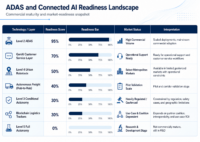
Together, these layers make autonomous vehicles one of the clearest test cases for enterprise Connected AI at scale.
Why Business Leaders Should Pay Attention Now
Autonomous vehicles create value in three broad ways: they improve operational efficiency, unlock new revenue models, and reshape customer experience.McKinsey estimates autonomous driving could create $300B–$400B in revenue by 2035
Grand View Research projects the market could grow from 6.3 billion in 2025 to 78.4 billion by 2033. These are directional estimates, but they signal why capital is concentrating here.
The business value is not only in the vehicle. It sits in the ecosystem around it: fleet orchestration, AI-powered customer service, predictive maintenance, usage-based insurance, payments, and data products. Companies that evaluate autonomous vehicles only as transportation assets will miss the larger platform opportunity.
Real-World Use Cases Already Emerging
Several high-profile deployments illustrate the range of near-term opportunity.
Robotaxis and AI-Orchestrated Mobility. Waymo has continued expanding its autonomous ride-hailing operations and closed a .6 billion funding round in October 2024. The strategic value extends beyond driverless rides. Robotaxi networks create a service layer where AI coordinates routing, demand forecasting, pricing, support, payments, and safety monitoring. However, in June 2026, Waymo issued a recall affecting nearly 3,900 U.S. vehicles after its automated driving system risked entering active freeway construction zones at speed. No crashes were reported, but the event confirmed that real-world operating environments remain difficult to govern. Autonomy must be treated as an operating model, not just a product feature.
Autonomous Freight and Logistics. In December 2024, Volvo Autonomous Solutions and DHL Supply Chain launched autonomous freight operations in Texas using the Volvo VNL Autonomous powered by the Aurora Driver. Freight may be the most commercially practical near-term application because routes can be more controlled than dense urban environments. For logistics leaders, the opportunity is creating an AI-enabled freight network where vehicles, warehouses, customers, and planning systems coordinate continuously.
GenAI-Powered Customer Service. When there is no driver in the vehicle, the customer support layer becomes more important, not less. GenAI agents can assist riders with trip changes, safety questions, delays, accessibility needs, lost items, refunds, and incident reporting. IBM has described GenAI’s customer-service role as helping summarize interactions, suggest responses, and support agentic workflows that resolve routine issues. In autonomous mobility, that capability is especially valuable. Critically, GenAI does not need to control the vehicle to create value. It can operate in the surrounding service layer, where the risks are easier to manage and the business case is clearer.
Blockchain for Logistics Auditability. Distributed ledgers can support trusted records for freight custody, vehicle identity, maintenance history, battery provenance, insurance claims, and regulatory audits. However, the discontinuation of TradeLens, the Maersk-IBM blockchain trade platform, is a useful cautionary example. Blockchain only works when the ecosystem adopts it. It should not be deployed because it is technically interesting. It should be adopted only where multi-party trust, auditability, and shared records are genuine bottlenecks.
Insurance, Compliance, and Safety Analytics
Autonomous vehicles generate continuous telemetry. For insurers, that data supports usage-based pricing and faster claims investigation. For fleet operators, it improves maintenance planning and risk monitoring. For regulators, it provides visibility into automated driving performance. But telemetry also raises difficult questions around data ownership, litigation discoverability, privacy, and how companies explain automated decisions after an incident.
As vehicles become more software-defined and connected, cybersecurity becomes a core business risk. ISO/SAE 21434 provides a framework for road-vehicle cybersecurity engineering, and its relevance is growing as connected vehicles expose more software, API, cloud, and supply-chain attack surfaces.
What the Market Signals Suggest
The market is growing, but unevenly. Public estimates point to strong long-term potential, while real-world deployment remains constrained by safety, regulation, geography, weather, infrastructure, and cost. Adoption will not happen all at once. It will advance use case by use case, city by city, and operating domain by operating domain.
What the Market Signals Suggest
The market is growing, but unevenly. Public estimates point to strong long-term potential, while real-world deployment remains constrained by safety, regulation, geography, weather, infrastructure, and cost.
| Market signal | What it suggests |
|---|---|
| McKinsey estimates autonomous driving could create $300B–$400B in revenue by 2035 | Long-term revenue potential is substantial, especially in software, services, and mobility platforms. |
| Grand View Research projects the AV market could reach $378.4B by 2033 | Forecasts remain bullish, though definitions vary across reports. |
| Waymo raised $5.6B in 2024 | Capital is concentrating around companies with deep AI, mapping, fleet, and safety capabilities. |
| The AI customer service market is projected to reach $83.9B by 2033 | The service layer around autonomous systems may mature faster than full autonomy itself. |
| Recent AV recalls and operating restrictions continue | Safety assurance and public trust remain gating factors for broad adoption. |
The key takeaway is that adoption will not happen all at once. It will advance use case by use case, city by city, lane by lane, and operating domain by operating domain.
The AI customer service market alone is projected to reach 3.9 billion by 2033, suggesting that the service layer around autonomous systems may mature faster than full autonomy itself. Early movers in fleet orchestration, AI-powered support, and data services may capture significant value before full autonomy becomes mainstream.
A Timeline for Disruption
2026 to 2028: Expansion of robotaxi pilots, wider Level 2 and Level 2+ adoption, early autonomous freight lanes, and GenAI service integration. Companies should pilot bounded use cases and build governance before scaling.
2029 to 2032: More robotaxi coverage in selected metros, broader freight automation, and tighter integration with customer service and logistics platforms. Competitive advantage shifts toward companies that can orchestrate connected ecosystems.
2033 and beyond: Autonomous mobility becomes a mainstream option in high-density and high-control environments. Business models evolve around autonomous fleets, mobility-as-a-service, data monetization, and AI-operated logistics networks.
Strategic Risks Business Leaders Cannot Ignore
Safety failures can trigger recalls, lawsuits, operating restrictions, and long-term trust erosion. Regulatory uncertainty varies across cities, states, and countries. Cybersecurity exposure expands across software, cloud, APIs, and suppliers as vehicles become more connected. High implementation costs cover sensors, maps, depots, remote operations, safety validation, and insurance. Data ownership disputes over vehicle, customer, and incident data will be strategically valuable and legally sensitive.
Customer trust gaps are equally important. Riders and shippers need confidence in safety, accountability, and support quality before autonomous mobility reaches mainstream adoption.
Major Key Players in the Autonomous Vehicle and Connected AI Market
The autonomous vehicle market is not led by one type of company. It is an ecosystem made up of robotaxi operators, automakers, AI chip suppliers, autonomous trucking firms, mapping providers, ride-hailing platforms, logistics companies, and cloud/AI infrastructure providers. That makes the competitive landscape broader than the traditional automotive market.
For WCA, the most important players are those shaping the connected AI stack around autonomous mobility: sensing, decision-making, customer experience, logistics orchestration, fleet operations, and data infrastructure.
Key Player Landscape
| Category | Major players | Strategic role |
|---|---|---|
| Robotaxi and autonomous mobility operators | Waymo, Tesla, Zoox, Baidu Apollo Go, WeRide, Pony.ai, Mobileye, Nuro, Uber | Deploying or enabling autonomous ride-hailing and urban mobility services |
| Autonomous trucking and logistics | Aurora, Gatik, Kodiak Robotics, Volvo Autonomous Solutions, DHL Supply Chain | Applying autonomy to freight, middle-mile delivery, and hub-to-hub logistics |
| Automakers and vehicle platforms | Tesla, Mercedes-Benz, General Motors, Toyota, Hyundai, Volvo, Geely, Lucid | Integrating ADAS, Level 3 systems, software-defined vehicles, and AV-ready platforms |
| AI chips and compute infrastructure | NVIDIA, Mobileye, Qualcomm, Tesla, AMD, Intel | Providing the compute layer for perception, planning, simulation, and in-vehicle AI |
| Ride-hailing and fleet platforms | Uber, Lyft, Grab, Didi | Providing demand aggregation, customer access, routing, pricing, and fleet marketplace infrastructure |
| Logistics and supply-chain platforms | DHL, Maersk, UPS, FedEx, Amazon | Potential adopters and ecosystem partners for autonomous freight and logistics automation |
| Cloud, simulation, and data infrastructure | Google Cloud, AWS, Microsoft Azure, NVIDIA Omniverse | Supporting model training, simulation, digital twins, fleet learning, and connected services |
Most Strategically Important Players
1. Waymo
Waymo remains one of the most advanced commercial robotaxi operators. It has moved beyond testing into paid driverless operations and continues to expand across U.S. cities. Its strategic importance comes from the way it combines autonomous driving software, fleet learning, mapping, safety operations, and consumer-facing mobility services within Alphabet’s broader AI and cloud ecosystem.
Waymo also highlights the maturity challenge facing the market. In June 2026, the company recalled nearly 3,900 robotaxis because of the risk that vehicles could enter freeway construction zones, showing that even leading AV systems still face difficult real-world edge cases.
What this means for business: Waymo demonstrates how autonomous vehicles can evolve into AI-operated service platforms, not just transportation assets.
2. Tesla
Tesla is a major player because of its scale, vehicle data, software-defined architecture, and Full Self-Driving strategy. Unlike many AV companies, Tesla is pursuing autonomy through a camera-led approach and mass-market consumer deployment rather than only geo-fenced robotaxi operations.
Its strategic advantage is the size of its connected vehicle fleet and its ability to distribute software updates directly to customers. However, Tesla’s current systems still require human supervision, so it should be viewed as a leading autonomy contender rather than a fully deployed driverless robotaxi leader.
What this means for business: Tesla shows how software, data, and over-the-air learning can turn vehicles into connected AI endpoints.
3. Mobileye
Mobileye is one of the most important suppliers in the ADAS and autonomous driving ecosystem. It provides computer vision, sensing, mapping, and autonomous driving technology to automakers. Mobileye has also announced plans to launch a U.S. robotaxi service in 2027, signaling a potential shift from supplier to mobility operator.
What this means for business: Mobileye connects two important markets: today’s ADAS adoption and tomorrow’s autonomous mobility services.
4. Zoox
Zoox, owned by Amazon, is developing purpose-built autonomous robotaxis rather than retrofitting conventional cars. Its strategy differs from Waymo and Tesla because the vehicle itself is designed around the robotaxi experience.
What this means for business: Zoox represents a mobility-as-a-service-native model, where the vehicle, AI system, customer experience, and fleet operations are designed as one integrated platform.
5. Baidu Apollo Go
Baidu Apollo Go is one of China’s leading robotaxi platforms and benefits from Baidu’s broader AI capabilities, mapping assets, and domestic mobility ecosystem. China remains one of the most important AV markets because of its urban density, policy experimentation, and strong domestic AI ecosystem.
What this means for business: Baidu shows how autonomous mobility can be integrated into broader smart-city, mapping, cloud, and AI infrastructure.
6. WeRide and Pony.ai
WeRide and Pony.ai are important China-linked autonomous driving companies with international ambitions. They are active across robotaxis, autonomous buses, freight, and related mobility applications. WeRide has reportedly planned a significant robotaxi fleet expansion, including delivery of 2,000 GXR robotaxi units in 2026.
What this means for business: These companies show that the AV race is global and will likely involve regional ecosystems rather than one universal winner.
7. Aurora
Aurora is one of the leading U.S. autonomous trucking companies. Its Aurora Driver system is designed to operate across multiple vehicle types, including freight-hauling trucks and passenger vehicles. In 2026, Aurora announced a carrier relationship to scale an autonomous fleet to 500 trucks.
What this means for business: Aurora is strategically important because autonomous freight may reach commercial viability earlier than broad consumer autonomy in some markets.
8. Gatik
Gatik focuses on autonomous middle-mile logistics, connecting distribution centers, warehouses, and retail locations. This narrower operating domain gives it a practical commercialization path because routes are repeatable and easier to validate than broad open-road autonomy. Gatik describes itself as operating daily middle-mile routes for major North American retailers.
What this means for business: Gatik is a strong example of bounded autonomy: solving a specific logistics problem before attempting universal self-driving.
9. NVIDIA
NVIDIA is a foundational infrastructure player rather than a robotaxi operator. Its chips, simulation platforms, and AI compute stack are central to autonomous driving development across perception, training, simulation, and in-vehicle inference.
What this means for business: NVIDIA sits at the center of the AI infrastructure layer that enables autonomous vehicles, digital twins, simulation, and connected vehicle intelligence.
10. Qualcomm
Qualcomm is increasingly important in software-defined vehicles through its Snapdragon Digital Chassis platform. The company reported strong automotive traction, including $1.1 billion in automotive revenue and a $45 billion design-win pipeline, positioning it as a major supplier for AI-powered, connected, and software-defined vehicles.
What this means for business: Qualcomm is helping automakers transition from hardware-centric vehicles to AI-enabled connected platforms.
What Companies Should Do Now
For organizations evaluating autonomous vehicles or adjacent connected AI opportunities, the most practical approach is to start narrow, govern early, and scale only when the operating model is proven.
Start with bounded, high-value use cases in controlled environments: logistics yards, ports, campuses, fixed freight lanes, airport shuttles, and mapped urban service zones. Treat the vehicle as one part of a broader value chain. The larger opportunity sits in fleet orchestration, customer experience, predictive maintenance, insurance, payments, and data services.
Build governance before scaling. Create a cross-functional operating model covering safety, legal, cybersecurity, privacy, compliance, vendor management, incident response, and AI risk. Use GenAI in the service layer first, well away from safety-critical driving decisions. Validate blockchain with business logic, not enthusiasm. Negotiate data rights early in any partnership with AV operators, OEMs, cloud vendors, or logistics firms. And design for graceful failure, with clear fallback processes, customer escalation paths, and incident communication protocols ready before any deployment goes live.
The companies that build trusted, secure, and interoperable connected AI ecosystems around autonomous mobility will define this market as much as the companies building the vehicles themselves.
Source: wca.org
Optimized with ai-productivitysuite