
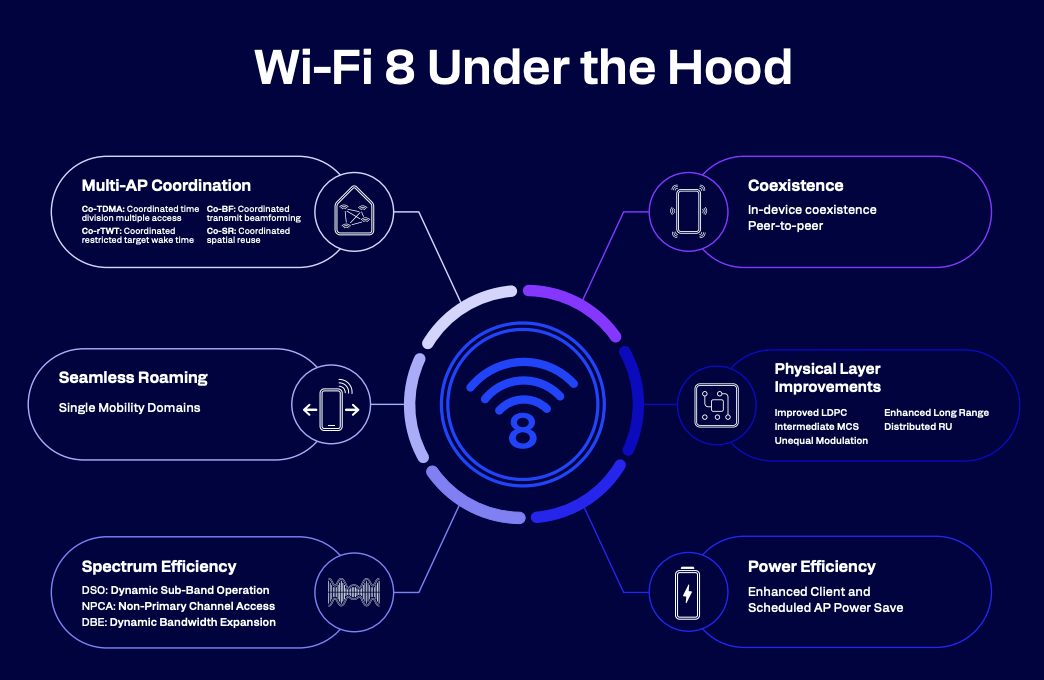
IEEE timing, early silicon, certification plans, and future Wi-Fi work are coming into focus.
The Wi-Fi 8 standard is on track, even as early silicon and product plans move ahead of final approval. For wireless executives, the key point is timing: first products may arrive in 2027, while certification and final approval are expected in 2028.
Wi-Fi 8 moves from chips to products
The Wi-Fi 8 standard is moving forward on a steady path. Chipset vendors have begun to offer early silicon, and device makers are preparing first products.
Even so, the formal IEEE timeline has not changed. According to Qualcomm standards leader Rolf de Vegt, Draft 2.0 of IEEE 802.11bn may receive approval at the July IEEE 802.11 working group meeting in Montreal.
That milestone matters because Draft 2.0 often means the core features are stable enough for product planning. As a result, vendors can move ahead while the standards process continues.
Standards timing remains measured
Early product news can make Wi-Fi 8 look closer than it is. However, IEEE 802.11bn still follows the normal cadence for major Wi-Fi releases.
After Draft 2.0, the group usually shifts to fixes, reviews, and later draft votes. Final IEEE approval is now expected in May 2028. Meanwhile, the Wi-Fi Alliance is expected to launch Wi-Fi 8 certification at CES 2028, ahead of final IEEE approval.
For wireless executives, this creates a clear planning window. First Wi-Fi 8 products may appear in 2027, but broad ecosystem alignment should build closer to certification.
Why Draft 2.0 matters for vendors
Draft 2.0 gives silicon vendors, device makers, and infrastructure suppliers a stronger base for design choices. Therefore, it helps reduce risk before mass product cycles begin.
This pattern is familiar in Wi-Fi. Chipsets and early devices often arrive before formal certification. Then, certification helps buyers compare products and gives enterprise teams more confidence in interoperability.
As a result, early Wi-Fi 8 activity should be read as a signal of market preparation, not as a sign that the standard is complete.
New work expands the Wi-Fi roadmap
IEEE 802.11 is also advancing several related efforts. Integrated millimeter wave work in IEEE 802.11bq aims to bring 60 GHz links into the Multi-Link Operation framework.
In practical terms, that could let future Wi-Fi systems add millimeter wave as another link. This may support high-capacity use cases where short-range performance and low latency matter.
Meanwhile, the Ambient Power task group, IEEE 802.11bp, has approved major parts of draft text. It now targets Draft 1.0 in September. Ambient power could help small devices run without batteries by harvesting energy from RF signals or other nearby sources.
AI offload and the path toward Wi-Fi 9
IEEE 802.11 has also started work around AI offload. This effort explores how Wi-Fi clients could move AI inference tasks to access points with embedded compute, or to nearby edge AI devices.
In parallel, the group is shaping early plans for the next major Wi-Fi standard. Likely use cases include AI-driven applications, immersive media, industrial robotics, mission-critical operations, mobile APs, residential broadband, hyper-connected IoT, and transportation.
Actual Wi-Fi 9-generation standards work for mainstream bands below 7 GHz is expected to begin in early 2027. For now, Wi-Fi 8 gives the industry a practical bridge between current deployments and a more intelligent wireless edge.